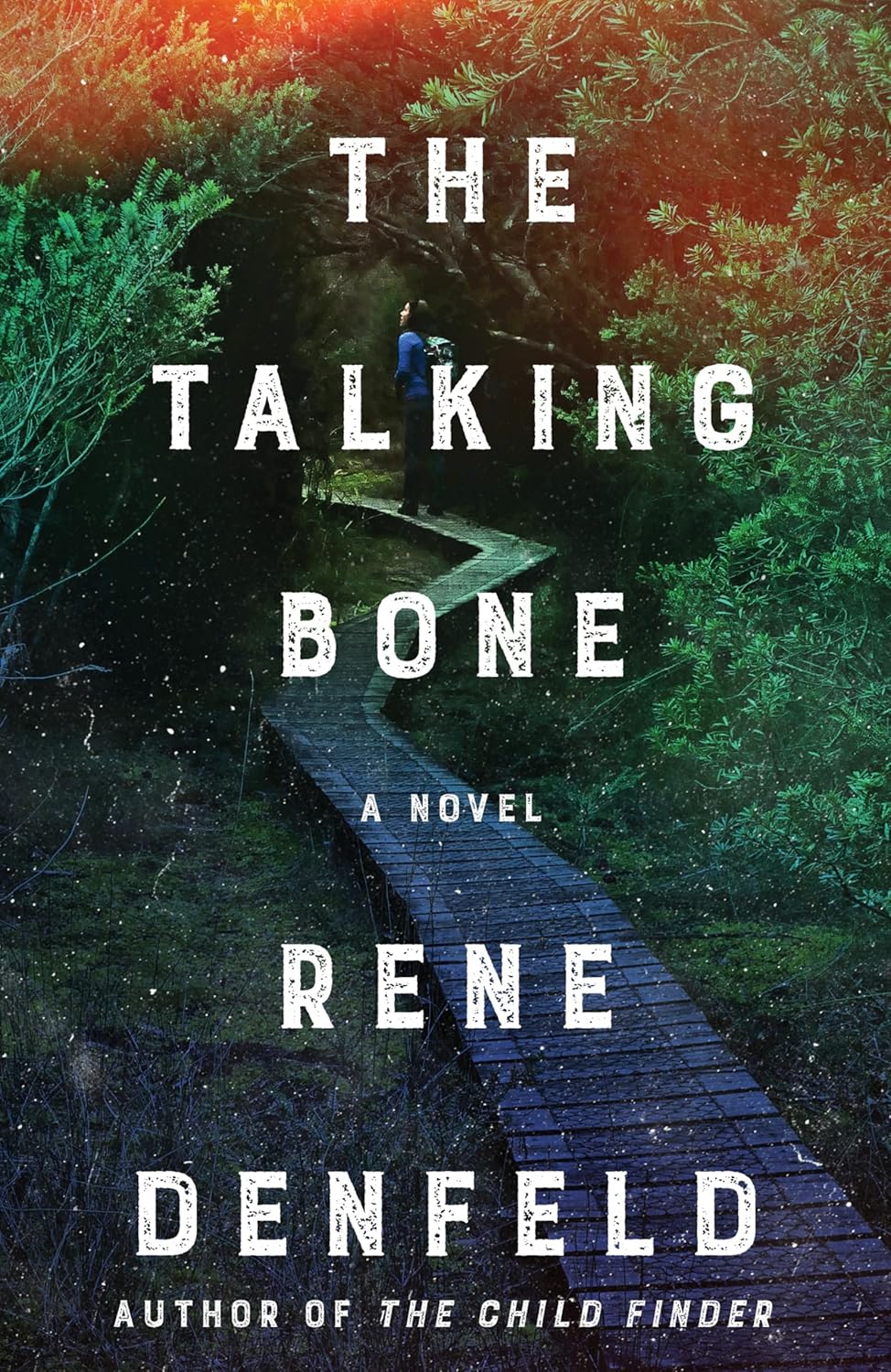
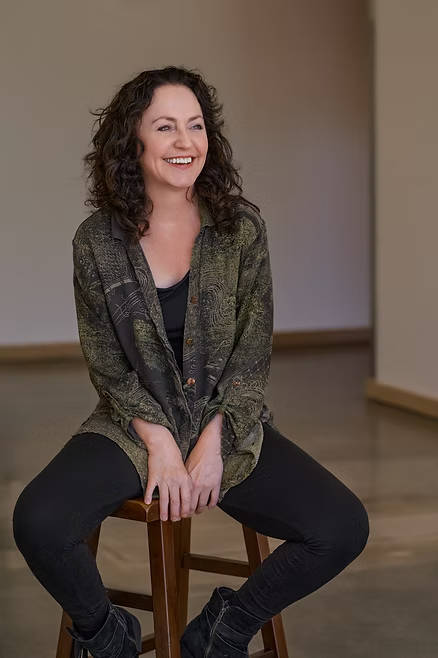
Since the release of her first novel, The Enchanted, in 2014, Rene Denfeld has been one of the hottest fiction writers in the Northwest. Her second book, The Child Finder (2017), was lauded by CrimeReads as “a hauntingly beautiful, chilling novel by a real-life badass heroine.” And her newest book, The Talking Bone, which debuts on July 21, has already received high praise from BookList, Kirkus Reviews, Publisher’s Weekly, and Library Journal. Kirkus calls it “powerful and haunting,” and CrimeReads describes it as “a gut-punch of a novel with as much beauty as it has pain.”

In just over a decade of publishing fiction – including the novels The Butterfly Girl (2019) and Sleeping Giants (2024) – Denfeld has received a French Prix du Premier Roman Etranger award, a listing for the ALA Medal for Excellence in Fiction, and a listing for the International Dublin Literary Award as well as consistently excellent reviews.
But she is more than just a successful novelist. She has also published nonfiction and worked for years as a licensed defense investigator, helping with death row and human trafficking cases, among others.
Denfeld has also been an foster and adoptive mother for several children and helped numerous writers as a writing coach. She and her family live in Portland.
For more information on Denfeld, her books, and her justice work, go to renedenfeld.com.


Rene Denfeld
WNW: What aspect of the Northwest do you feel hasn’t been adequately addressed in writing yet?
I’d say mass incarceration and poverty. We want to have such an idyllic view of the Pacific Northwest: snow-covered mountains, cold seas, and fertile valleys. But this is also a place of terrible poverty and oppression. We hide our prisons here in remote places, but we have them all the same, and we exile thousands every year. We vanish people here to terrible places. We also have some of the most punitive laws in the country.
There’s been studies showing how we incarcerate people of color at rates that make the South look good. People often say Oregon is a white state. I’d say it’s a state that makes it very hard to be a person of color. You can step inside a prison or jail here and the story becomes clear.
WNW: How would you characterize your approach to the Northwest in your own writing?
I spend a lot of time traveling the state for my justice work, and whether it is the coast or desert or mountains, it’s always stunning. I love the interplay between the settings and the people here, and how they inform each other. As a writer, I feel the setting is its own character. I love to capture the beauty of our area, especially when it is unexpected.
WNW: What is your favorite book about the Northwest and why do you like it?
I love the old-school writers here like Ken Kesey. Sometimes a Great Notion and One Flew Over the Cuckoo’s Nest are classics. So is Geek Love by Katherine Dunn. You can’t skip Hard Rain Falling by Don Carpenter either, or Trask by Don Berry. I think Northwest writing is a very unique combination of blue collar work, timber industry, the influence of the rain and the majesty of the area.
WNW: What is one of your favorite passages about the Northwest from your own writing?
Here’s an excerpt from my new novel, The Talking Bone, about the main character, Ruby Spencer, who is raised in Old Town in Portland:
“In the old warehouse district along the Willamette River, Ruby ran as free as a bird. She played among the breweries polluting the air with the rich, redolent smell of hops. She made friends with men playing dice and whist outside corner shops. She learned to weave a cane chair from an old man without legs on her floor of their building. She pried windows open with butter knives for old ladies. She felt like her legs were loose here. She was free.
“’No,’ she told her mother, time and again, when she asked if Ruby was interested in the beyond: a circular place where the kids all looked the same, and wore starched clothes like the Brady Bunch, and did the same things, like attended the same school, and had men with faces like butchers for dads.
“Here in Old Town, the kids who lived in the old apartment buildings went to whatever school they could, usually riding the city bus, and in the summers they earned extra money by taking the rickety berry bus to the fields outside of town, where farmers paid them a quarter a flat, and she ate berries and felt the fine sun on her face. She could discover the world here, and the world was wonderful: It was big and actually without danger. Of course, there were creeps and cretins, as her mother cautioned her: Desirée had told her about the men where she had grown up, always stealing her nose, but Ruby knew about them— and she knew how to run.
“She could run here.”
~ ~ ~ ~ ~
The launch for Denfeld’s new novel, The Talking Bone, will take place at Powell’s Books in Portland at 7 p.m. on Thursday, July 23. She’ll be in conversation with author Lidia Yuknavitch.
Denfeld will also be talking about her book at Oregon Literary Arts in Portland at 6:30 p.m. on Tuesday, August 11.
Other links:
Video: Northwest Passages Book Club interview about Sleeping Giants
Radical Acts of Imagination: An Interview with Rene Denfeld by the Fiction Writers Review
Note: I’m an affiliate of Bookshop.org, where your purchases support local bookstores. If you buy a book through a click on this website, I’ll earn a small commission that helps defray the costs of maintaining WritingtheNorthwest.com.